Background: What led to this
Academically, I have led a journeyman’s life and my previous work [1] has spanned network sciences, statistical physics, information theory, computational social science, machine learning, human kinematics, computer vision and data ethics. I have a dual PhD (ECE + CS) from Carnegie Mellon University where my doctoral thesis [2] investigated the phenomenology of the information contagion on Online Social Networks (OSNs) using tools from Graph Theory, Statistical Physics and Communication Theory.
In my recent capacity as the CEO of HAL51 AI, I had to don the role of an LLM-whisperer updating our guard-railing mechanisms every week to ensure our real-world deployed educational co-pilots [3] would stay on course in a sensitive setting such as a classroom. This has given me the proverbial ring side view on how young minds interact with AI-powered novel interfaces. This idea came to me in the midst of a noisy classroom in Fremont last year.
The core idea of mindset propagation probing
In my previous work on “Latent Sentiment Detection in Online Social Networks: A Communications-oriented View” [4], I had investigated an exemplar manifestation of viral mindset propagation on social networks by modeling “Hashtag-Hijacking” on Twitter using Markov Random Fields (MRFs). This resulted in a communications-theoretic framework for characterizing the probability of error of detecting the underlying latent sentiment that introduced a new factor: Network topology.
Recent advancements in large language modeling (LLM) have given us the three requisite ingredients:
- Natural conversation generation: Large language models with ability to simulate human-styled natural conversations.
- Mindset absorption: Fine-tuning methods that allow us to harvest the conversations and inflict internal weight changes.
- Mechanistic probing: A Persona Vectors Framework (PVF) [5] that allows us to probe, measure, locate, assign and manipulate personas associated with these large language models.
To this end, I propose a rigorous empirical framework of modeling mindset propagation by simulating a social network of LLMs.
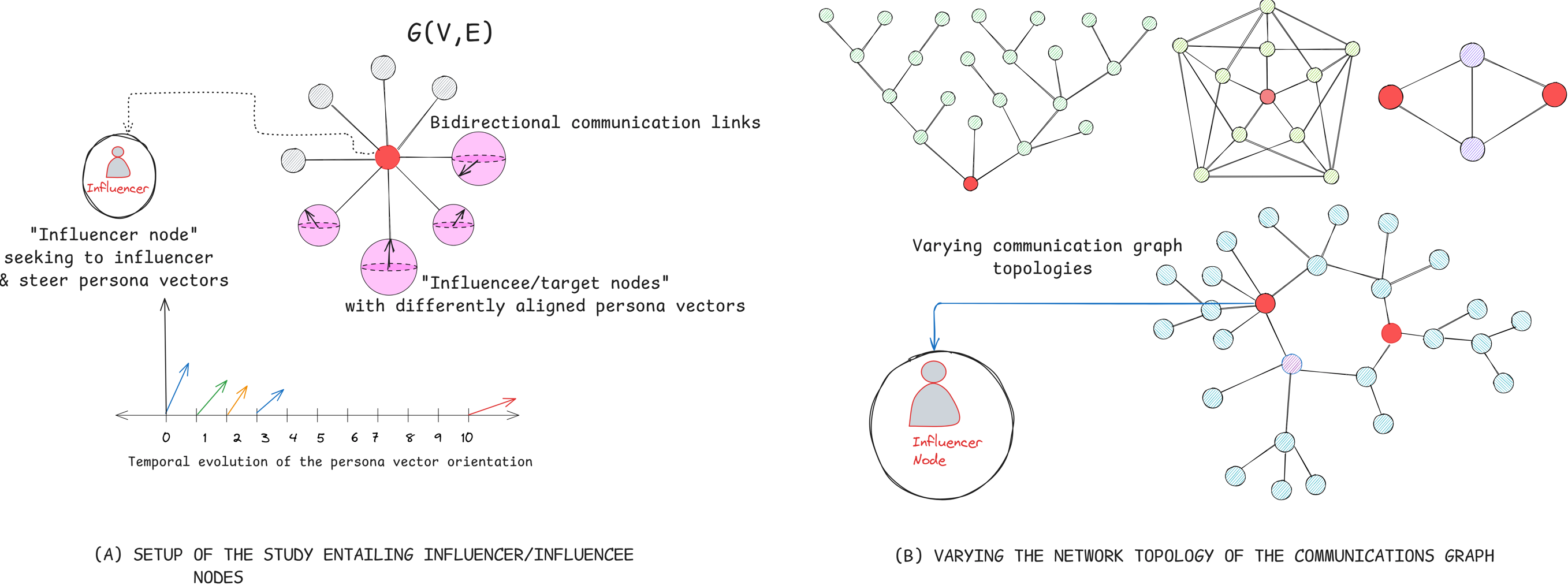 Figure 1: Mindset propagation in social networks of LLMs
Step-wise rendition of the underlying framework
- We begin with a pre-fixed topology $G_{fixed}(V,E,W)$. We define Influencer nodes and Influencee nodes.
- The mandate of the influencer node is to propagandize and use persuasive conversations to alter the mindset of the influencee nodes.
- We facilitate Contiones styled sessions spanning a few hundred conversations.
- After every session, the influencee nodes go through a reflection phase to fine-tune internal weights.
- The sessions repeat and we track the temporal evolution of the mindstate of the influencee nodes.